
TITICACA—THE SOURCE OF THE SUN
Lake Titicaca is among the most popular geographic features in the world. You’ll find it in every other crossword and TV or radio game show; children learn its bizarre name—remote and tempting–at a very early age and find it an alluring source of puns and word play. And although most people retain only the strange syllables and an odd fact or two, many of them actually start dreaming of visiting these mythical waters.

Titicaca deserves its fame with its 9,000 square kilometers although it is neither the largest lake in South America, as the old text-books claim (Maracaibo in Venezuela is almost double in area) nor is it the highest navigable lake in the world. There are lakes with boats sailing on them in Chile and Tibet located much higher than 3,800 meters above sea level.
Of course Titicaca owes its attraction to features other than erroneous geographic statistics. The basin accommodating the waters of the lake is located on the border between the modern Latin-American states of Peru and Bolivia. It is part of the vast semi-desert valley, known as Altiplano. With an altitude of 3,600 to 4,000 meters above sea level and surrounded by snow-covered mountain chains reaching an altitude of 6,500 meters above sea level, it is the most extensive high plateau in the whole of America. Sheltered on all sides by natural barriers and located in the immediate vicinity of a huge water basin, this area could be characterized as the Mesopotamia of the New World. Add to this the fact that according to the local cosmogony the Sun and the Moon were born deep in the lake… and the mysticism of Titicaca is secured forever.
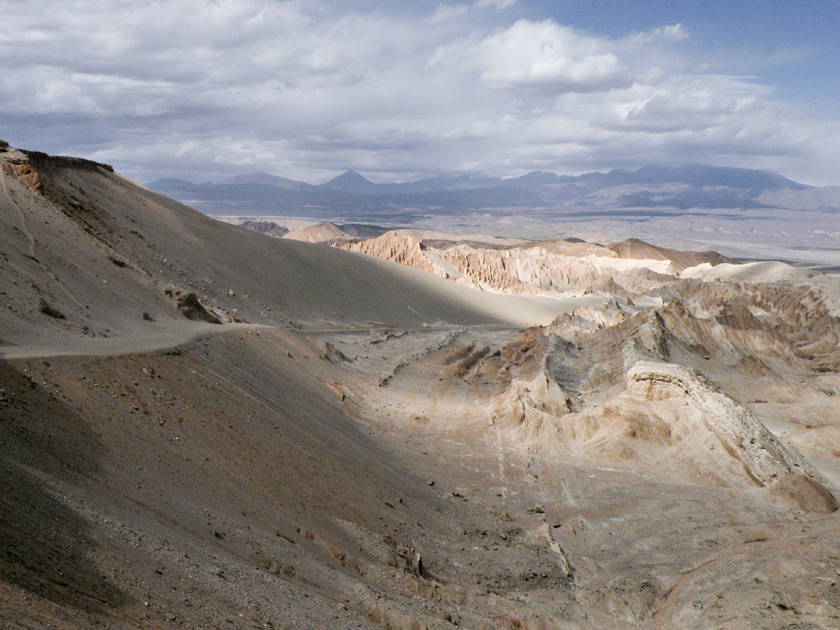
Actually, one’s very first impressions of the astoundingly blue waters shimmering in the crystalline air—which, at an altitude of 4,000 meters, is afflicted by oxygen deficiency—are that the lake is charged with huge natural power and historical energy. The oldest evidence of an ancient civilization in the area dates to the middle of the first millennium BC. However, the culture that left the most durable traces at Titicaca in the pre-Inca period was Tiwanaku (Tiahuanaco). Flourishing between 600 and 1100 this culture is characterized by phenomenal religious cult architecture, stone sculpture and other religious effigies that even today are among the mysteries archeologist can’t explain. There are also no satisfying explanations for the mysterious disappearance of the Tiwanaku civilization either, which simply ceased to exist around the 11th century.
After the decline of Tiwanaku, the Colla and Aymara cultures appeared, traces of which are spread all over the frosty Altiplano. While traveling on a crowded bus from Juliaca to Puno—the main port town on the Peruvian shore—I see a sign “Sillustani” to the left of the road and immediately realize that I have arrived. Sillustani is the main burial complex of the Colla culture, whose representatives were quite warlike, and who, until the arrival of the Incas in the 15th century, ruled alone over Titicaca. Later they were assimilated into the growing Inca Empire. The Colla people buried their eminent dead in specially built massive towers on a rocky peninsula in the Umayo Lake which resemble petrified rockets connecting the earth with the heavens. In the rapidly gathering twilight of the tropical day, the shadows of these ten-meter-high cylinders seem to fly over the calm surface of the lake.
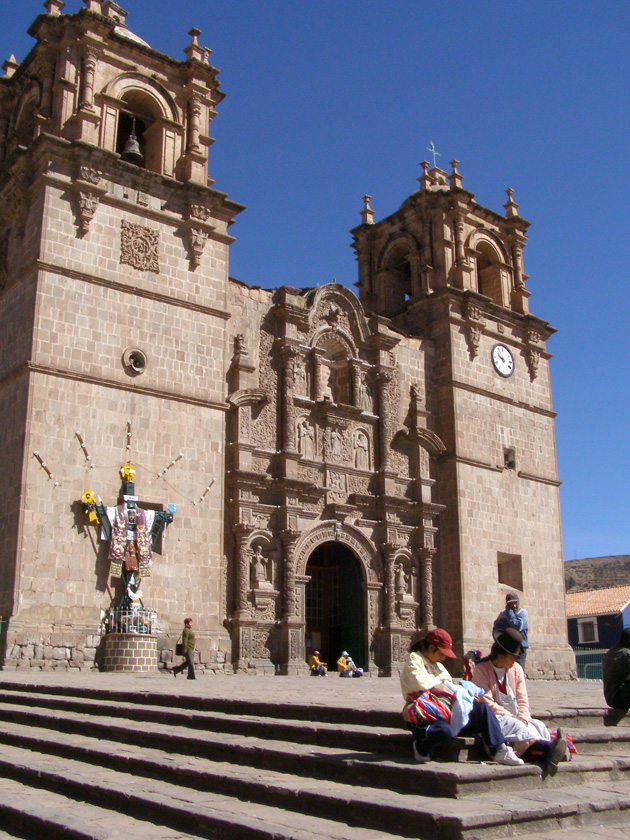
The city of Puno is located in a vast, shallow bay at the western end of Titicaca, where the Uro tribe once lived peacefully. The inappeasable Colla warriors, however, couldn’t stand peaceful coexistence. In order to escape their armed terror, the Uros came to an original solution. The mud-banks of the lake are thickly overgrown with reeds—a special Southamerican species called totora—which the local inhabitants used as food, building material and what not. In this case the endangered Uros built a fleet of huge reed rafts, loaded them up with all their belongings and commenced living on them in the lake, far away from the shores and from the fierce raids of the Collas. This is how they survived over time: They were born and they died on these islands of totora not caring about the vicissitudes on the mainland. Their descendants live in the same way until this day. Well, today, of course, they have motor boats and go ashore to exchange the fish they have caught for flour and sugar. And, the curious tourists who visit them add a coin or two to their natural economy. It is not difficult to find a boatman at the harbour of Puno who will–for a decent pay–agree to take me out to the place in the bay where the lake people live. We settle on a price of 100 suns—“sol”, sun, is the currency of Peru. He navigates through the infinite fields of totora along narrow canals connecting the reed islands. The islands nearer to the shore look quite tidy and have almost everything you find on the mainland: a church, a school, a shop, public telephone. Their territory is also considerable—some reach 500 square meters and have more than 80 residents. Don’t think, however, that there is no social division there—the well-off families are easily recognizable by the presence of solar batteries and transistor radios. As for the construction of the island itself, all “newcomers” participate equally in the building process.
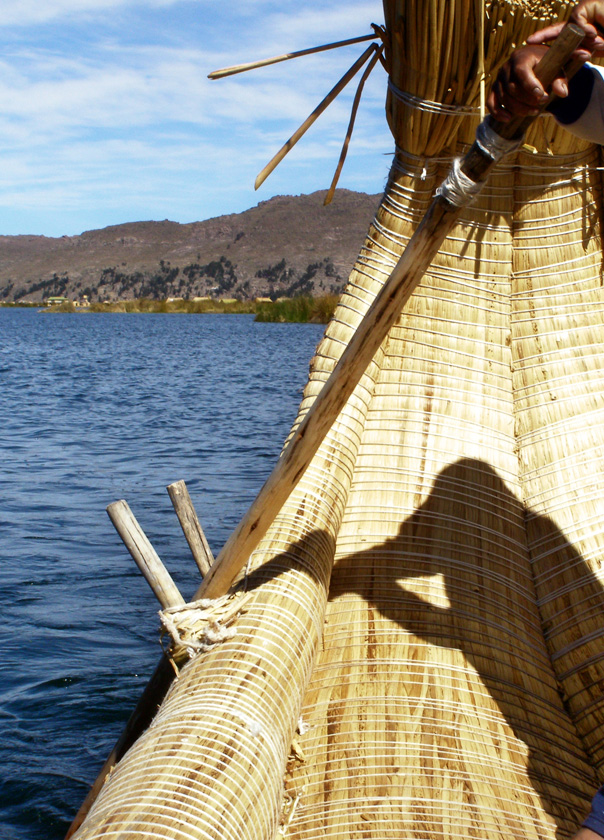
Then we visit a brand new island called Capicruz. The elder, Yupanaki, tells us that a year ago he set up a cooperative of six families with the purpose of building Capicruz, which took them nearly seven months. The platform covers an area of 100 square meters and its thickness is up to one and a half meters. As the bottom of the island rots fairly quickly and it slowly sinks, its height is maintained by constantly adding new layers of totora. Gravitation functions very strangely here—when you walk, your feet not only spring, but also sink in the elastic surface. …Until you stumble across a rotten section, where you get stuck as in a real swamp.
In addition to the floating homes of the Uros, there are several spectacular natural islands in Titicaca: Takile and Amantani in Peruvian waters, and Isla del Sol and Isla de la Luna in Bolivian. Back in Puno I get on a big modern looking motorboat whose engine turns out to be not so modern and chokes all the time, so that we need half a day to reach Amantani. The island has two villages with 4,000 inhabitants, and its slopes—as is true everywhere the Incas have passed through—are cut into numerous agricultural terraces. At the harbour there is a welcoming party with everybody dressed neatly as for a holiday. In fact, the arrival of the motorboat is tantamount to a holiday. The foreigners on board will be accomodated in local residents’ homes (there are no hotels here), but in a fixed order so that nobody is slighted and every household receives its modest share of the nascent tourism in these parts.
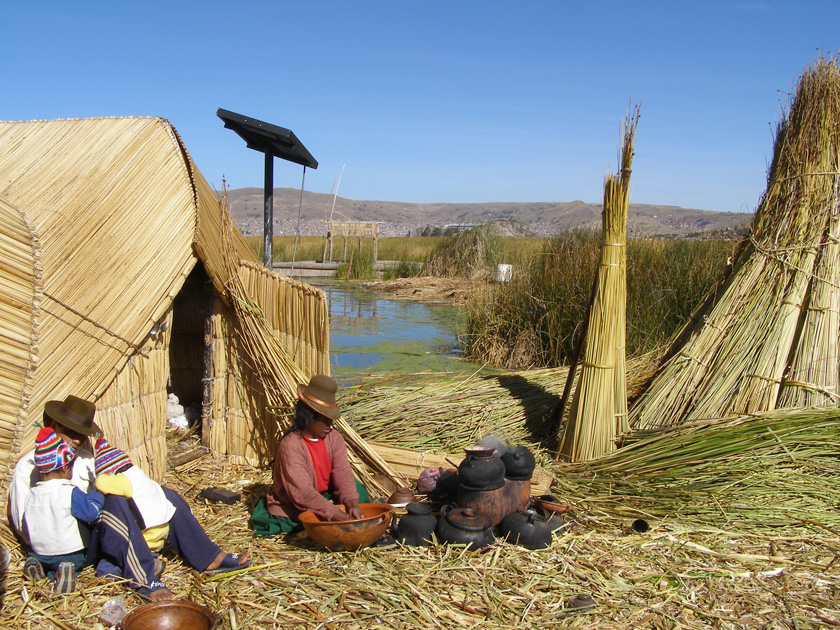
My hostess is a young woman named Marisa. Her house lies on a slope and while we are climbing it she tells me about the island’s way of life. Everything grows with difficulty at this altitude and requires a lot of work. Potatoes never grow bigger than walnuts. “But you have electricity,” I say, noticing the cables between the houses. “Not any more. The unit turned out to be very expensive and nobody can pay.”
Until dusk I walk in the surrounding area coming across different ruins from unknown times. On the top of the island there is a sanctuary of Pachamama and Pachatata—the female and the male principals in the local mythology. I come home on time for dinner–as I am told by Marisa that afterwards there will be a surprise. Food is quite authentic. “Quinoa” soup–quinoa being a local legume resembling semolina; then “karachi”—a small fish, garnished with “oka”—a root vegetable tasting like carrots, and “chuño”—sweet potatoes. A real treat! And all this accompanied by large quantities of “mate de coca”–the famous Andean tea made of dried coca.
The surprise after dinner is a fiesta in the school. All men are dressed up in gay, coarse-wool ponchos and the women are with monochrome, crinoline resembling knee length skirts and brightly embroidered blouses. The dances continue until midnight.
The next morning Marisa comes with me to the pier dressed again in her her Sunday best. We bid farewell as if we have known each other for years and I take the motorboat to the next island, Taquile. She, while knitting, climbs back to her modest home on the slope, which I keep in sight till we turn round the cape.
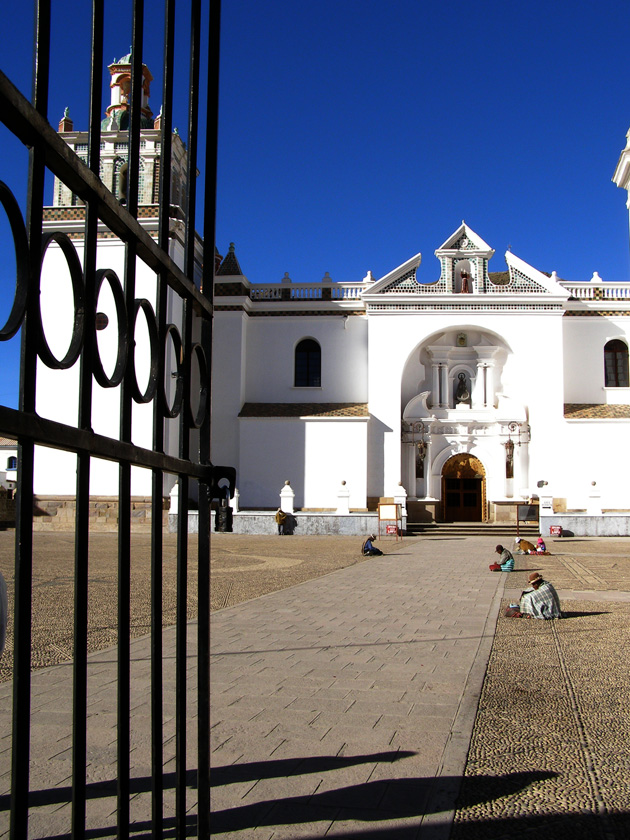
After the “pagan” Amantani, Taquile reminds me that Titicaca and the whole of Altiplano went through a period of Spanish colonization. In the main village of the island I find the typical Latin American quadrangle with a beautiful arch and an old Catholic church on one side. Although they adopted Christianity, the local Indians interwove it with some of their pre-Columbian beliefs and traditions resulting in an interesting religious conglomeration. The feast I had the chance to attend was Pentecost, and I am sure the ritual in Rome and Lima would look completely different.
I continue to the southeast along the shore of Titicaca and enter Bolivian territory. There is no indication that you are in another country neither by the people, nor by the landscape. I stop in a bumptious little town with an imposing white marble church and a melodious name—Copacauna–or as the foreigners call it, finding it easier–Copacabana. This is the starting point for Isla del Sol, the most religious island in Titicaca. Not only was the son born here, but also—according to the ancient legends—the pale-faced bearded creator god of the pre-Columbian mythology, Viracocha, emerged here from the depths of the lake. In accord with these legends, the Incas believed that the founder of their imperial dynasty, Manco Capac, was also born on this island.
If you climb to the top of Isla del Sol at dusk and look to the east where the waters of Titicaca glisten like a jewel, and above them the icy ridge of Cordillera Real shines like an unearthly augur, you’ll be able–at least to a certain extent–to understand why this special piece of land is connected to such mystical events for the ancient cultures of South America.
With the light dying, I go down to the shore of Isla del Sol. Several pack llamas with red threads bound to their ears as protection against bad luck catch up with me. The south winter sun climbs down its slanting road to the horizon and in a minute will sink in the bronze waters of the lake only to emerge again in the morning—reborn and worshipped. Above me the bell of the adobe church from Spanish times tolls for the evening prayer. The eucalyptus trees around me quickly soak up the shadows of the night coming from the black outlines of Isla de la Luna across the lake, where—if everything’s correct—the moon should be born in a while.
USEFUL INFORMATION
To visit Titicaca and the surrounding landmarks is comparatively easy and quick. If you come from the Peruvian capital, Lima, the best thing to do is to fly to Cusco ($80) and then take a bus from there to the harbour of Puno (6 hours, $7). And from the Bolivian capital, La Pas, there is a regular bus service to Copacabana (4 hours, $3).
Puno and Copacabana are the two most suitable starting points for a visit to the islands in the lake. The water transport is well organized and cheep.
Accommodation in the above-mentioned towns is up to standard. Most hotels are new and tidy, and the prices vary between $10 and $15 for a double room with en suite bathroom on a bed and breakfast basis.
Puno as well as Copacabana abound in restaurants and other eating places. All kind of food is on offer here, including fresh fish from the lake, which is a must actually. A rich portion of baked trout for example costs $4-5. An average pizza–$3, milanesa with pommes frites–$4. If you choose a fixed price menu it will cost you much less—a soup and a main course (usually rice with something) will amount to less than $2. Beer is expensive—over $1,50 for 330 ml in a restaurant—and the quality is poor.
As the climate round Titicaca in the dry touristic season (Mai-September) is quite harsh, don’t forget your warm clothes; you’ll need them. Remember that the high altitude necessitates a day or two of acclimatization before you embark on adventures.