
ALTIPLAN0—LIFE IN THE THIN AIR
The human body is perniciously fastidious. In order to function well it needs laboratory conditions with unlimited quantities of thick fresh air and no startling temperature amplitudes. Luckily for mankind the planet Earth has secured all this near to its surface. However, when we start going up—and for good or bad people have always had this chronic striving to look at the sky—things start changing, and after only three to four kilometers up in the atmosphere the air becomes so thin that we begin to have a headache.
The ancient civilizations of the Old World were all born at sea level and thrived there for a long time without venturing into higher altitudes. These were considered the realm of the supernatural, not the mundane, material world. Only when the aggressive curiosity of Alexander of Macedonia in the 4th century BC incited the ancient people to step across its limits, did it become clear that it was more difficult to live in the mountains than on the plains. During the military expedition to India, after entering what is the today the land of the Afghan Hindu Kush, Alexander of Macedonia’s soldiers started feeling an unexplainable weakness accompanied by a headache and stomach problems. The chroniclers of the campaign documented—maybe for the first time in history—the initial symptoms of altitude sickness, or acute mountain sickness (AMS) as it is described and known today. According to them the cause of the mass indisposition was rooted in the stench of some mysterious alpine herbs that saturated the air and destroyed the human organism.
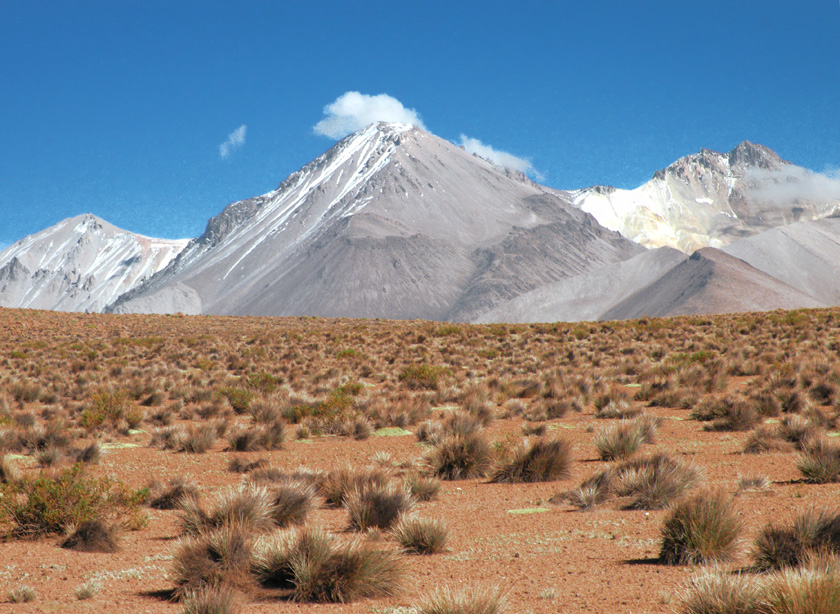
For the ancient civilizations of the New World, however, and more precisely for those from the region of the Andes in South America, the heights were their home and they knew altitude sickness very well. They had also found a preventive remedy against it: the sacred plant coca. Even today, the miners who keep digging precious metals in mines situated at an altitude of over 6,000 meters above sea level in Chile and Bolivia constantly chew dried leaves of coca to protect themselves from the attacks of “soroche.” Located in the territory of four countries—Bolivia, Peru, Chile and Argentina—the South American Altiplano is not only the high-mountain cradle of the pre-Columbian cultures but also a unique geographical phenomenon. It is a huge plateau with an average altitude of about 3,800 meters above sea level that has one, and only one, counterpart in the world: the Tibetan plateau, the mighty roof of Asia. Sheltered in the snowy embrace of the Andes, Altiplano is a harsh land where travelers can expect all kinds of adversities. However, they will land in a unique environment, and if they open their senses they will be generously rewarded.
If you are too impatient like me and decide to reach the heights of Altiplano by air, the moment you land on the highest civil airport of the planet, El Alto in Bolivia, you inevitably will feel at least thirty years older. All of a sudden the body subjected to oxygen deficiency loses its inherent energy and even the simplest physical actions require much strength and time. Thinking gets slower and perception more difficult. And this is just the beginning. Before long the first symptoms of altitude sickness appear—headache, nausea, palpitation—and due measures have to be taken. The most efficient one is going down to a lower level. But how? You have landed on a plateau surrounded by six thousand meter high mountain peaks… In this case the only way out is the specific topography of the Bolivian capital, La Paz, starting at an altitude of 4,100 meters above sea level and coming down to 3,200 meters in a cascade of buildings and streets along a narrow pass. It’s needless to specify where the most expensive hotels of the city are located…
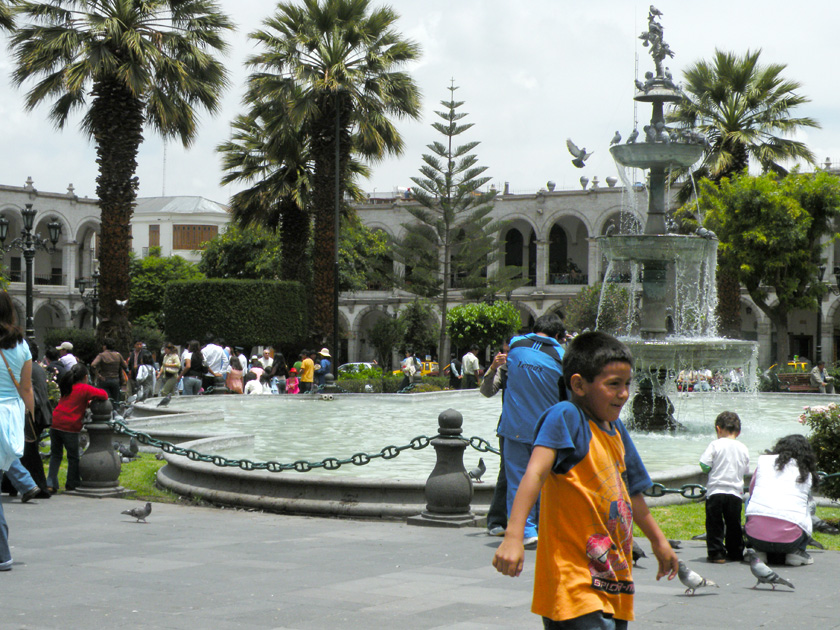
Having learned from my painful experience, I decide—on my second visit to these (for me) enchanting places—to be more careful and take a bus from Arequipa in Peru to Puno on the shore of Titicaca. The eight-hour journey still offers the chance of partial acclimatization and when I set foot on the colonial cobbled street of the lake city, my steps—although stiff—are not like a diver’s steps, and my head is comparatively clear. Lake Titicaca is located at an altitude of 3,900 meters above sea level in the northwestern end of Altiplano. Like everywhere at such high altitude, the air here shines as if it produces light itself. Unrestricted by vegetation and other natural or artificial hindrances, the horizon goes as far as Cordillera Real outlining the plateau in the east. To the south the distance is endless. I will travel more than 600 kilometers southward to the end of Altiplano—to the place where the borders between Bolivia, Chile and Argentina meet.
The oldest cultural layer of Altiplano belongs to the pre-Columbian civilization Tiwanaku that came into existence as far back as before our era. The heyday of the state and its development into empire was in the 3rd century AD. The apogee of Tiwanaku lasted eight whole centuries. However, at the beginning of the 11th century serious changes in the climate occurred, connected mostly with an abrupt drop in precipitation in the area. The flourishing civilization started rapidly to decline and when two centuries later the new rulers of the Andes, the Incas, came here they found only abandoned megalithic buildings. The Inca Empire ruled over Altiplano until the arrival of the Spanish conquistadors in the 16th century. However, the inhospitable climate prevented the Incas from founding permanent settlements. As before, the main ethnic group here remained Aymara. They were obviously the only Indians who, in the course of centuries, managed to adapt to the harsh conditions of this altitude. Today, two million of them live within the limits of their motherland, Altiplano, having passports of one of the four Andean countries.
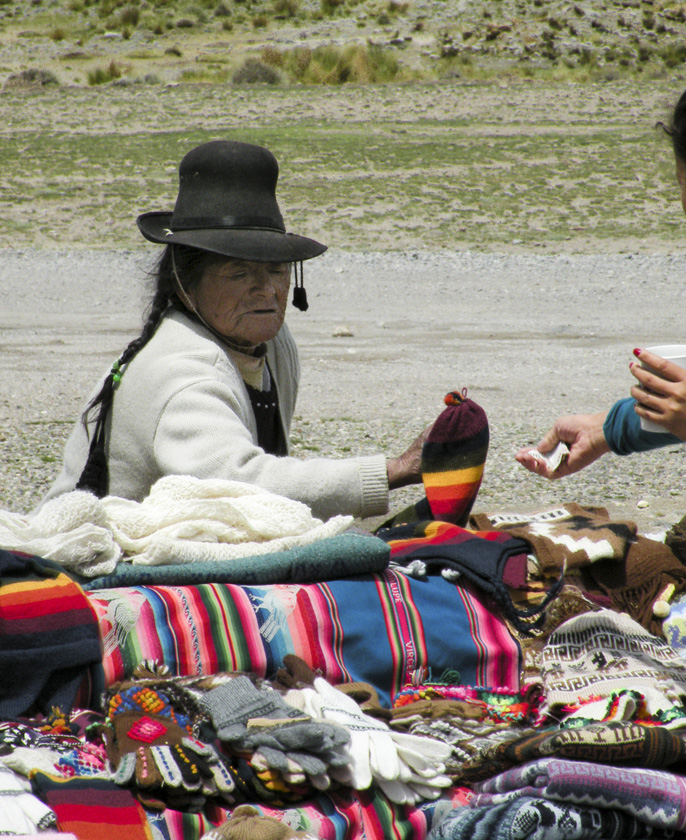
Besides me, there are only Aymara Indians on the night bus to Uyuni. The end of June is approaching and the people in the Northern Hemisphere are already going to the beach. Here, however, to the south of the equator, all the more at an altitude of 4,000 meters above sea level, the local people wear warm sweaters and llama and alpaca wool hats. Llama and alpaca are the South American sheep and goat. God only knows why there is no heating in the Bolivian buses—they consider it probably an extravagant caprice—which turns the night passage of the alpine wilderness into a punishment. As you can guess, there is a terrible draft in the jalopy vehicle, and the outside temperature of -22 degrees Celsius doesn’t differ very much from the temperature inside. I have been to a lot of freezing places but I have never felt such a cold as in the night buses of Altiplano.
The daylight finds me in a field glittering with snow. Here it is so dry, where did this snow come from? My thinking is dulled by the ugly cold so that I need time to realise that this is just salt. One of the main characteristics of Altiplano is the salt lakes. Salar de Coipasa and Salar de Uyuni are the biggest and most amazing ones. And in the middle there is an island overgrown with antediluvian cacti resembling a surrealist painting.
Uyuni is a border train station with the invariable colonial square and a cathedral. The people are reserved the way Indians are, and some of them even prefer not to talk Spanish but just their mother tongue. Nevertheless I manage to negotiate with one of them to take me in his jeep to the Chilean border a three-day journey on dirt roads. We set off right away although I am still stiff from the freezing night torment. In the beginning we drive straight through the salt. Soon the land behind us vanishes and we sink into blinding whiteness. We drive for hours through the amazing diamond-shaped symmetry of the salt crystals following old car tracks, as otherwise orientation without a compass is impossible. Only late in the afternoon we come out and start moving among the motley rocks of uninhabited volcanic land. While the traces of human presence were perfectly clear up until I reached Uyuni, from now on we see only derelict miner’s buildings and wild animals. We go to Laguna Colorada, a shallow lake with an absurd red colour to the water caused by the presence of strange minerals in it. Long-legged flamingos walk stiff like puppets on the scarlet surface. We are not in a hurry to continue. Our gigantic shadows stretch out into the lake tearing the cool shroud of the slanting sunbeams. We spend the night in a kind of workers’ hostel. We are treated to a stew with potatoes and llama meat. The meat is tough but nourishing. We drink industrial quantities of mate de coca—an infusion from the dry leaves of the disputed plant—in order to enhance our body warmth and neutralize the attacks of altitude sickness.
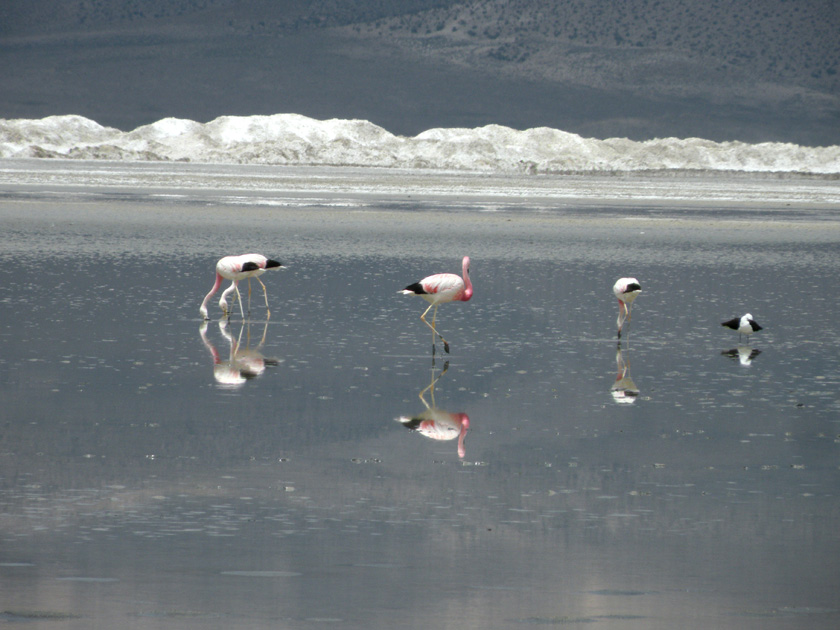
In the morning the lake looks petrified, as in the fairy tales. The water is covered by an ice crust that has taken captive hundreds of birds sticking out on one leg in a lifeless stupor. Gradually the light gets more intense, the air shakes off its frosty breath and life starts again. Now I understand why flamingos never stand on both legs in the water. The bird ensures in this way a free leg to break the night ice and escape the trap without having to wait for the frozen surface to melt. Like in the previous days, we keep running into big herds of vicuña. Along with the larger guanaco this is the other camelid species typical of South America from which the domestic llama and alpaca originated. From time to time the long-legged shadows of the South American ostriches, nandu, dash hastily across. The colour of their feathers blends with the surroundings to such a degree that—when they are not moving—it is impossible to make them out. Such a protection is not guaranteed to the fox soro, which darts like a rusty flame among the dusty thorn-bushes chasing all sorts of rodents and other prey.
Many people consider the high mountain plateaus monotonous and depressing, but I don’t agree with this and don’t even notice the time it takes to get to the foot of Licancabur, a six thousand meter high volcano. Its classical cone is reflected in the venomously green waters of Lake Laguna Verde. Here it is too high and too cold, and you don’t spot any life on its shores. Right behind the volcano begins Chile. I am not in a hurry to pass the border check-point which is a windy wooden shed perched on the rocky ridge. There, I get on a Chilean jeep of some kind and in an hour I come down from the top of Altiplano to the oxygen-rich scorching heat of the desert oasis San Pedro de Atacama.
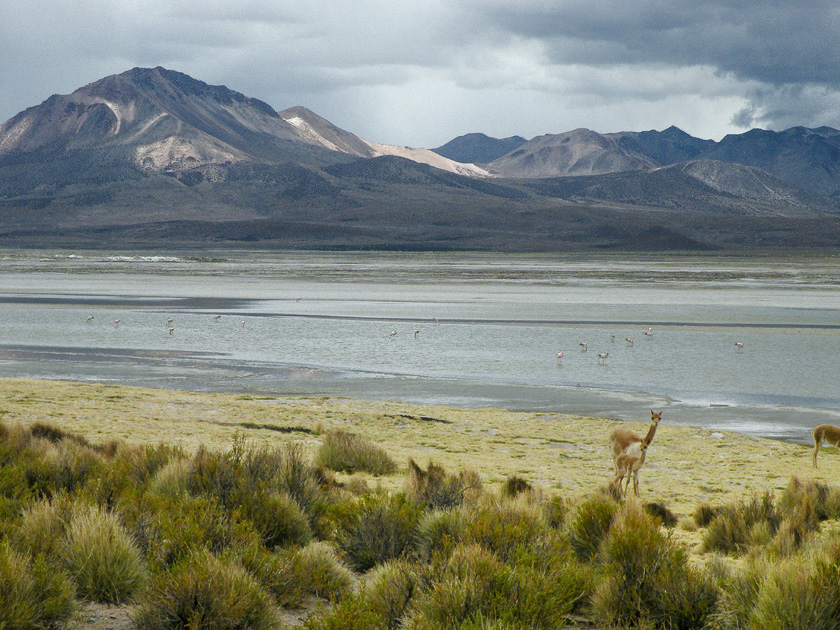
Three years later, I came back to Altiplano. This time, with Elena, we set off from Arica, the waterside city in the northernmost end of Chile. We passed through the Atacama Desert, dried up by the aridity, and reached the coolness of Altiplano—coolness sharpening the senses. Days on end we wandered at the foot of steaming volcanoes stopping by salt lakes as well as in unreal small adobe villages with small white churches and friendly inhabitants who gave us shelter and food. I felt happy as if on a visit to an old acquaintance. The most delightful thing, however, was that the undemonstrative fine charm of this frowning land, which at first sight looks quite repulsive, was obvious this time not only to me but to Elena as well.